Came across a post by Felix (a local investor in mid 30s who have
achieved financial independence) which I find very meaningful and
resonates greatly with me.
Rephrased and share:
"
In today's world with so much social media, we are too pressured to be like others.
Most, if not all, of my friends are trying to do the same thing.
Get a high paying job, get married early, big wedding, fancy honeymoon,
tie themselves down with 30 year loan with big car and house, eat
restaurant and buy branded.
End up keep complaining they are poor, ask me how they can earn more money, ask me teach them how to "play" stocks and get rich.
I tell them, I'm just an average investor, just that I have a simple
lifestyle. Spend little and invest most of my money, let it grow for
close to a decade then have today.
Do they follow my advice? Nope. They just brush me off, think I CSB.
"
------------------------------------------------------------------------------------------------------------------------------
How true! This short post completely sums up what I think of the world today and on investing.
Sorry, but we don't know how to "play" stocks.
We are not super talented stock picker like Warren Buffett.
We don't know any way to get rich quick.
We just live a simple lifestyle, invest regularly and let time do its thing.
Monday, February 22, 2016

Monday, February 15, 2016
Revelation From The Bear Market
As of this writing, I have already suffered 5 digits "losses" from my investments in the first bear market of my investing life.
I don't know why people are always trying to figure out where interests rate will go, what the Fed will do next, what China government will do next, etc...
Macro-economy -> Country specific economy -> Sector outlook -> Company
All these are "upstream" factors are so far away. We already have difficulty forecasting a company earnings, why are you trying fruitlessly to guess the impact of macro-economic decisions beyond your control?
Just go straight to the source - company earnings, balance sheet, debt profile, economic moat. You will make way better decisions then trying to figure out what the Fed wants to do, how it will affect the market and in turn how it will affect your company.
Have you heard of Singtel subscribers cancelling their mobile plans because of "Yuan devaluation"?
Neither have I.
5. Ignore the Media and Analysts
If you believe every piece of nonsense they write, you will be in a world of pain. They are the greatest "prata-flippers" in the world and I have seen how fast their target prices and economy outlook can change overnight.
It is okay to read their opinions, forecasts and figures, but always do your own diligence and form your own decision. In 2014 when Keppel fell to $8, every analysts were forecasting $12. It is sitting at $4 now.
6. Ammo Management
If you are losing sleep, you are over-allocated. Diversify, buy solid companies and keep a large war chest.
Pinning these down makes my thoughts and "acceptance" of this bear market clearer.
From this year onward, I am going to treat my portfolio like an investment company, where I am the CEO. I think it is a great way to enhance my investment acumen and understand each of my business better.
Look forward to my "1st quarterly earning reports" soon!
"Far more money has been lost by investors preparing for corrections, or trying to anticipate corrections, than has been lost in corrections themselves." -Peter Lynch
Compare to people I know, I must say I am least emotionally affected. How do I build up this resiliency?
If I have to guess, it's because what I focus on are largely different from other people.
--------------------------------------------------------------------------------------------------------------------------
1. Focus on Cash Flow
I have always kept my goal of investing in mind - generate enough cash flow to attain financial independence.
A
simple analogy: You brought a shop for $10000 that generates $1000 for
you every year. 2 months later, others are buying/selling that shop for
$5000. Are you going to panic sell your shop? Or are you going to buy
more?
When I first make a
decision to buy a stock, I am already satisfied with the yield. As long
as the company fundamentals are intact/does not cut dividends, I will
receive the exact amount each year, regardless of how much that
investment is selling for on the market right now.
This is one of the biggest advantage of dividend investing compared to growth investing.
Note: It is a different matter altogether if the company cuts dividends and/or fundamentals are affected. In that case, more evaluation will be needed.
Note: It is a different matter altogether if the company cuts dividends and/or fundamentals are affected. In that case, more evaluation will be needed.
2. Focus on Fundamentals, Not Marco-Economy
I don't know why people are always trying to figure out where interests rate will go, what the Fed will do next, what China government will do next, etc...
Macro-economy -> Country specific economy -> Sector outlook -> Company
All these are "upstream" factors are so far away. We already have difficulty forecasting a company earnings, why are you trying fruitlessly to guess the impact of macro-economic decisions beyond your control?
Just go straight to the source - company earnings, balance sheet, debt profile, economic moat. You will make way better decisions then trying to figure out what the Fed wants to do, how it will affect the market and in turn how it will affect your company.
Have you heard of Singtel subscribers cancelling their mobile plans because of "Yuan devaluation"?
Neither have I.
3. Ignore Real Time Pricing
We
are too affected by the "real-time" nature of stock prices because it
is updated every second. Comparatively, in property investment, we don't
care what the price is until we want to sell it. We don't have access
to a real time price tag on our house 24/7. We need an agent to thorough
valuation and find buyers, etc...
If
you brought a property for $500k last month and today someone knock on
your door and offer you $400k for it. Are you going to sell your house?
Or are you going to tell that person to f-off?
We should view stocks in the same
way. If you have no intention of selling it, why should you care how
much others are paying for it at this moment?
4. Stock Prices Are Not Reflective Of True Value
Most
people don't realize this, but the stock price is actually set by a
VERY small percent of people in the market. For example, Singtel have a
total of 16 BILLION shares, and its average volume per day is 25
MILLION. That's less than 1 percent!
In other words (for most companies), the majority of shareholders are not doing anything most of the time.
To
put it into perspective: let's say 100 people own an iPhone. 99 of them
are happy using it and 1 guy in desperation for cash decides to sell
his for $1. That becomes the "price" of that iPhone for that day. Does
this imply that the iPhone is worth $1? (Note: Of course, this is an
extreme example)
I am sure the answer is no.
A
company true value is dictate by how much profits it can make for you,
NOT by how much one percent of its shareholders are willing to sell it
for at any one time.
5. Ignore the Media and Analysts
If you believe every piece of nonsense they write, you will be in a world of pain. They are the greatest "prata-flippers" in the world and I have seen how fast their target prices and economy outlook can change overnight.
It is okay to read their opinions, forecasts and figures, but always do your own diligence and form your own decision. In 2014 when Keppel fell to $8, every analysts were forecasting $12. It is sitting at $4 now.
6. Ammo Management
If you are losing sleep, you are over-allocated. Diversify, buy solid companies and keep a large war chest.
--------------------------------------------------------------------------------------------------------------------------
Pinning these down makes my thoughts and "acceptance" of this bear market clearer.
From this year onward, I am going to treat my portfolio like an investment company, where I am the CEO. I think it is a great way to enhance my investment acumen and understand each of my business better.
Look forward to my "1st quarterly earning reports" soon!
"Far more money has been lost by investors preparing for corrections, or trying to anticipate corrections, than has been lost in corrections themselves." -Peter Lynch
Monday, January 18, 2016
Warchest Deployment Plan
As the market continue being battered down, I am getting ready to pounce.
Personally, I don't feel that it will go down to the Great Financial Crisis (GFC) levels of 2008. Historically, the market retracts 10% once a year, 20% every 4 years, 30% every decade and 50% few times a century.
We are heading towards 30% correction, and in my opinion things are quite cheap already. STI are trading at low valuations of 10.5 P/E (historical average 16), something you don't see outside of big crisis.
Still, nothing is for certain and we must thread carefully. We don't want to use up all our ammunition in case the enemy is much stronger than expected. From now on, I will also eliminate all speculative buys (Super, Accordia, Oil & Gas) and focus solely on defensive stocks (i.e Companies that 99.9% will be around and make money for a long long time).
There are dozens of companies I want to pick up:
1. Telcos
Singtel, Starhub and M1 have all retracted to 2011 - 2012 levels, falling by 20 - 30% and giving yields from 5% to 7+%! With the projected 6.9m population, I would just buy all 3 telcos if I could.
Just ask yourself: Do you think your mobile plans will get cheaper or more expensive 10 years from now? Do you think people will use more or less data? I think it is obvious it is a "sure win" business. Just diversify across all of them to avoid any single one of them blowing up, and you will earn no matter how consumers churn from 1 to another.
2. REITs
Many well-managed and good REITs have corrected more than 20% and now giving yields over 7%.
Personally, I have been following Capital Commercial/Mall Trusts and Keppel DC REIT (very resilient) closely. If they drop just a bit more I will really want to pick them up.
3. SGX
A monopoly. Each time anyone buy/sell a stock, this company (only stock exchange in Singapore) makes money. How can this not be a good buy?!
The price has fallen from $8.8 to $6.8, a 20+% correction, with 4.2% yield now. This is despite much better results, higher dividends and a solid zero-debt balance sheet.
Looking to fire a bullet once it stabilizes.
4. ST Engineering
I am already holding a good amount, but current valuation are definitely inexpensive if we look at the historical price. Management have been doing share buybacks for like forever which limits the downside. The caveat is the lower earnings guidance by the management, but this is one company I can feel safe holding forever.
Share has fallen from $3.8 to near $2.8. If it maintains 16 cents dividends per year, that's over 5.5% yield. I will fire a bullet should it inches closer to $2.8. (There's 2 dividends payout coming very soon in April and August)
5. The Banks
All the banks have fallen greatly. DBS from $22 to $15+, OCBC from $11 to below $8. Some have even gone below its NAV!
To me, DBS and OCBC are like the "bluest of the blue chips". DBS is the lifeblood of Singapore and OCBC is the 'world's safest bank'. And they are trading at discount to book value!
IMO, they are some of the safest long-term bets you can make at current valuation.
6. Raffles Medical Group
This is the "least safe" stock on the list, but greatest potential with a wonderful growth story on the back of an aging population.
I always wanted to pick it up, but didn't because I feel it's too expensive. Despite falling 20% to below $4, it's still valued at over 30P/E. Will be keeping a closer watch.
----------------------------------------------------------------------------------------------------------------------------
Offensive Strategy
As much as I want to, I can't afford individual bullets on all 3 banks and Telcos as I won't be able to average down. Buying (and averaging down) one of them exposes me to too much company-specific risk.
After considering, I decided to revert to the most conservative strategy - Straits Times Index. Singtel + 3 Banks + Keppel makes up 50% of the STI. They will form the basis of my portfolio.
The STI basically let me pick up the 3 banks + Singtel which I do not yet have in my portfolio. The main advantage is I can fire bigger and fuller bullets, and most importantly average down without fear. I intend to launch 1 bullet for every 10 to 15 cents drop in the STI - let the war begin!
Defensive Strategy
To prevent any single collapse from doing too much damage, I will not be averaging down on individual companies (despite me really wanting to).
Aside from the STI, I will not allow any single holding to take up more than 20% of my equities base.
----------------------------------------------------------------------------------------------------------------------------
Current Troops Strength
Reserve Units: The defenders of my castle, my emergency funds and warchest. It is earning decent risk free interests and I intend to keep them at max strength. Most importantly, they are what keeps me sleeping peacefully at night, and I do not intend to deploy them unless some catastrophic event happens.
Ally Units: A separate battalion from the main force. There are about 3 company of troops here which I will use solely to whack the STI.
Regular Forces: I have 3 - 4 company at my command. 1 will be used against STI next week, with 1 more as backup. The other 2 shall be reserved for Starhub/ST Engineering/SGX/REIT, depending on how the situation changes.
Rearguard: About 2 company , but I do not know when they will join back to the main force. I look forward to your return!
Reinforcements: This is coming very soon, and will add a good amount of strength to the Regular Forces.
TO WAR!!! (time to boost my passive income gao gao)
"Do not fire until you see the white of their eyes."
- Battle of Bunker Hill, a colonial military command given to troops to hold their fire until the moment when it would have the greatest effect, especially in situations where their ammunition would be limited.
Personally, I don't feel that it will go down to the Great Financial Crisis (GFC) levels of 2008. Historically, the market retracts 10% once a year, 20% every 4 years, 30% every decade and 50% few times a century.
We are heading towards 30% correction, and in my opinion things are quite cheap already. STI are trading at low valuations of 10.5 P/E (historical average 16), something you don't see outside of big crisis.
Still, nothing is for certain and we must thread carefully. We don't want to use up all our ammunition in case the enemy is much stronger than expected. From now on, I will also eliminate all speculative buys (Super, Accordia, Oil & Gas) and focus solely on defensive stocks (i.e Companies that 99.9% will be around and make money for a long long time).
There are dozens of companies I want to pick up:
1. Telcos
Singtel, Starhub and M1 have all retracted to 2011 - 2012 levels, falling by 20 - 30% and giving yields from 5% to 7+%! With the projected 6.9m population, I would just buy all 3 telcos if I could.
Just ask yourself: Do you think your mobile plans will get cheaper or more expensive 10 years from now? Do you think people will use more or less data? I think it is obvious it is a "sure win" business. Just diversify across all of them to avoid any single one of them blowing up, and you will earn no matter how consumers churn from 1 to another.
2. REITs
Many well-managed and good REITs have corrected more than 20% and now giving yields over 7%.
Personally, I have been following Capital Commercial/Mall Trusts and Keppel DC REIT (very resilient) closely. If they drop just a bit more I will really want to pick them up.
3. SGX
A monopoly. Each time anyone buy/sell a stock, this company (only stock exchange in Singapore) makes money. How can this not be a good buy?!
The price has fallen from $8.8 to $6.8, a 20+% correction, with 4.2% yield now. This is despite much better results, higher dividends and a solid zero-debt balance sheet.
Looking to fire a bullet once it stabilizes.
4. ST Engineering
I am already holding a good amount, but current valuation are definitely inexpensive if we look at the historical price. Management have been doing share buybacks for like forever which limits the downside. The caveat is the lower earnings guidance by the management, but this is one company I can feel safe holding forever.
Share has fallen from $3.8 to near $2.8. If it maintains 16 cents dividends per year, that's over 5.5% yield. I will fire a bullet should it inches closer to $2.8. (There's 2 dividends payout coming very soon in April and August)
5. The Banks
All the banks have fallen greatly. DBS from $22 to $15+, OCBC from $11 to below $8. Some have even gone below its NAV!
To me, DBS and OCBC are like the "bluest of the blue chips". DBS is the lifeblood of Singapore and OCBC is the 'world's safest bank'. And they are trading at discount to book value!
IMO, they are some of the safest long-term bets you can make at current valuation.
6. Raffles Medical Group
This is the "least safe" stock on the list, but greatest potential with a wonderful growth story on the back of an aging population.
I always wanted to pick it up, but didn't because I feel it's too expensive. Despite falling 20% to below $4, it's still valued at over 30P/E. Will be keeping a closer watch.
----------------------------------------------------------------------------------------------------------------------------
Offensive Strategy
As much as I want to, I can't afford individual bullets on all 3 banks and Telcos as I won't be able to average down. Buying (and averaging down) one of them exposes me to too much company-specific risk.
After considering, I decided to revert to the most conservative strategy - Straits Times Index. Singtel + 3 Banks + Keppel makes up 50% of the STI. They will form the basis of my portfolio.
The STI basically let me pick up the 3 banks + Singtel which I do not yet have in my portfolio. The main advantage is I can fire bigger and fuller bullets, and most importantly average down without fear. I intend to launch 1 bullet for every 10 to 15 cents drop in the STI - let the war begin!
Defensive Strategy
To prevent any single collapse from doing too much damage, I will not be averaging down on individual companies (despite me really wanting to).
Aside from the STI, I will not allow any single holding to take up more than 20% of my equities base.
----------------------------------------------------------------------------------------------------------------------------
Current Troops Strength
Reserve Units: The defenders of my castle, my emergency funds and warchest. It is earning decent risk free interests and I intend to keep them at max strength. Most importantly, they are what keeps me sleeping peacefully at night, and I do not intend to deploy them unless some catastrophic event happens.
Ally Units: A separate battalion from the main force. There are about 3 company of troops here which I will use solely to whack the STI.
Regular Forces: I have 3 - 4 company at my command. 1 will be used against STI next week, with 1 more as backup. The other 2 shall be reserved for Starhub/ST Engineering/SGX/REIT, depending on how the situation changes.
Rearguard: About 2 company , but I do not know when they will join back to the main force. I look forward to your return!
Reinforcements: This is coming very soon, and will add a good amount of strength to the Regular Forces.
TO WAR!!! (time to boost my passive income gao gao)
"Do not fire until you see the white of their eyes."
- Battle of Bunker Hill, a colonial military command given to troops to hold their fire until the moment when it would have the greatest effect, especially in situations where their ammunition would be limited.
Saturday, January 16, 2016
CPF Investment Decisions
Since the start of the year, I have been doing a lot of reading on the
CPF system and many opinions on it. While I am still unconvinced about
voluntarily contributing to CPF, I have been deliberating on what to do
with the monies in CPF-OA.
Personally, I view the CPF as the "last line of defense" in our financial wealth. Hence, we should definitely spend some time to learn about it and manage it.
I have read extensively on 2 mainstream arguments, and their opposing stance can be best-represented by 2 bloggers. I will just summarize their points below:
AK and his CPF-SA
AK advocates transferring monies from OA to SA account while you are young to allow compounding to work its magic. Guess what, he receives more than $8000 a year from SA interest alone!!!
With the kind of interest he's getting, it is more than enough to cover all future minimum sum increases. Basically, his stance is to 'make full use of the government' to help you save for your retirement.
Some research: If say I transfer $20K from OA to SA (an additional 1.5 - 2.5% interest), I will receive an additional $600+ every year. That will result in an additional $20K in about 20 years time, and will definitely go a long way in meeting the minimum sum!
The appealing part of this is while we are young, our contribution percentage to SA is very low. However, SA pays the highest interest (5% on the first $40,000). If you are willing to give up the flexibility of OA, that extra 2.5% will grow your money much faster. Once it reaches a substantial amount, you no longer need to worry about future minimum sum increases.
Note: A possible "good problem" is that if your SA reaches the minimum sum, you can no longer do voluntarily contribution to reduce tax.
--------------------------------------------------------------------------------------------------------------------------
Keith from Investment Moats
On the other side, Keith highlighted the dangerous of doing such transfers.
Flexibility and Safety - Even though I have no intentions of wiping out my OA for housing, it's still a safety net. What if you lose your job and is unable to service your mortgage? OA gives you that last line of safety.
Political risks - It's 25 years to withdrawal and who knows how the rules may have changed by then. However unlikely, they may increase withdrawal age, reduce SA interest, etc... It's a risk of the unknown that we have to keep in mind.
Opportunity Costs - I am in a huge dilemma because of this. Doing the transfers "locks in" your monies until 55, at a fixed interest of 2.5%. There is the potential cost of delayed financial independence.
--------------------------------------------------------------------------------------------------------------------------
It's a choice between safety and opportunity.
In the end, the deal-breaker for me came down to this: Can I beat the 2.5% "risk free" rate in OA account?
According to the media, over 80% failed to do so. I find that quite unbelievable because the STI provides an average returns of 6% (as of now) over the long term. There's a few possibilities:
- Selective reporting in bear markets.
- Same reason why 90% of traders/hedge funds fail to beat the market, but 2.5% is really not high in my opinion.
All I need to do is to buy the STI, keep calm and collect dividends. This is especially so given the recent 25% correction (dropping from 3500 to 2600) - the yield alone (as of now) is already 3.6%, even if we were to exclude capital appreciation altogether). With that, I should hopefully beat the OA and possibly SA returns.
Even though I've never been through the GFC, I know I am not the kind of person that would panic-sell. I know I am a long-term investor, and I believe in the future of Singapore.
And so, I abandoned my initial plan of doing an OA to SA transfer, and opened an CPFIS account. I think I would re-look into doing a SA transfer in the near future if the market recovers and the investment pays off.
In conclusion, I still look at CPF-SA as a final safety net that I would likely never touch, unless some black swan event happens where STI crashes below 1500. 5% risk free interest rate is very very good good. On the other hand, I also want to adopt AK strategy, give myself a peace of mind and build up this safety net while I am young.
Personally, I view the CPF as the "last line of defense" in our financial wealth. Hence, we should definitely spend some time to learn about it and manage it.
I have read extensively on 2 mainstream arguments, and their opposing stance can be best-represented by 2 bloggers. I will just summarize their points below:
AK and his CPF-SA
AK advocates transferring monies from OA to SA account while you are young to allow compounding to work its magic. Guess what, he receives more than $8000 a year from SA interest alone!!!
With the kind of interest he's getting, it is more than enough to cover all future minimum sum increases. Basically, his stance is to 'make full use of the government' to help you save for your retirement.
Some research: If say I transfer $20K from OA to SA (an additional 1.5 - 2.5% interest), I will receive an additional $600+ every year. That will result in an additional $20K in about 20 years time, and will definitely go a long way in meeting the minimum sum!
The appealing part of this is while we are young, our contribution percentage to SA is very low. However, SA pays the highest interest (5% on the first $40,000). If you are willing to give up the flexibility of OA, that extra 2.5% will grow your money much faster. Once it reaches a substantial amount, you no longer need to worry about future minimum sum increases.
Note: A possible "good problem" is that if your SA reaches the minimum sum, you can no longer do voluntarily contribution to reduce tax.
--------------------------------------------------------------------------------------------------------------------------
Keith from Investment Moats
On the other side, Keith highlighted the dangerous of doing such transfers.
Flexibility and Safety - Even though I have no intentions of wiping out my OA for housing, it's still a safety net. What if you lose your job and is unable to service your mortgage? OA gives you that last line of safety.
Political risks - It's 25 years to withdrawal and who knows how the rules may have changed by then. However unlikely, they may increase withdrawal age, reduce SA interest, etc... It's a risk of the unknown that we have to keep in mind.
Opportunity Costs - I am in a huge dilemma because of this. Doing the transfers "locks in" your monies until 55, at a fixed interest of 2.5%. There is the potential cost of delayed financial independence.
--------------------------------------------------------------------------------------------------------------------------
It's a choice between safety and opportunity.
In the end, the deal-breaker for me came down to this: Can I beat the 2.5% "risk free" rate in OA account?
According to the media, over 80% failed to do so. I find that quite unbelievable because the STI provides an average returns of 6% (as of now) over the long term. There's a few possibilities:
- Selective reporting in bear markets.
- Same reason why 90% of traders/hedge funds fail to beat the market, but 2.5% is really not high in my opinion.
All I need to do is to buy the STI, keep calm and collect dividends. This is especially so given the recent 25% correction (dropping from 3500 to 2600) - the yield alone (as of now) is already 3.6%, even if we were to exclude capital appreciation altogether). With that, I should hopefully beat the OA and possibly SA returns.
Even though I've never been through the GFC, I know I am not the kind of person that would panic-sell. I know I am a long-term investor, and I believe in the future of Singapore.
And so, I abandoned my initial plan of doing an OA to SA transfer, and opened an CPFIS account. I think I would re-look into doing a SA transfer in the near future if the market recovers and the investment pays off.
In conclusion, I still look at CPF-SA as a final safety net that I would likely never touch, unless some black swan event happens where STI crashes below 1500. 5% risk free interest rate is very very good good. On the other hand, I also want to adopt AK strategy, give myself a peace of mind and build up this safety net while I am young.
Thursday, December 31, 2015
Year In Review 2015 - Financial Cash Flow
My first full year of the most comprehensive and detailed income/expenditures tracking finally completed!
*All figures exclude CPF, investment capital gains/losses (but include dividends).
-------------------------------------------------------------------------------------------------------------------------
Total Income VS Total Expenses
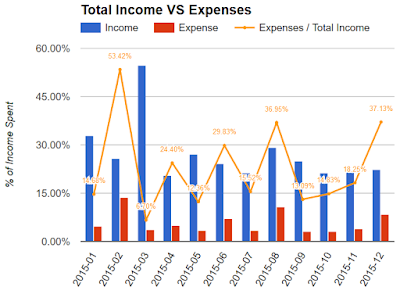 Expenses
were pretty much stable except for the months where I made "major
purchases", most notably a new mattress in February, Dividend Machine
course in April, Langkawi trip in June, Samsung Galaxy S6 in August,
Cameron Trip + S6 repairs in December. I also spent slightly more on
minor indulgence stuff in December to 慰劳 myself a bit.
Income were highest in January and March from bonuses, and there's a minor National Day bonus in August. Can't wait for the upcoming one to top-up my war chest!
 Other
fluctuations in income are mostly due to dividends payout. Being my
first year of investing, this will take some time to stabalize as I
"lock down" on the stocks I have (receiving full year worth of
dividends), and having each subsequent purchase make up less of my
portfolio.
Overall, I managed to saved near 82% of my total income. My plan is to reinvest and inject at least 70% into my portfolio every year. Let's get the snowball rolling!
-------------------------------------------------------------------------------------------------------------------------
Recurring Income VS Recurring Expenses

The chart strips out the noise and highlight only the "recurring" portion of my cashflow.
Recurring income include only salary + passive income, and excludes 'one-time' items like lottery winnings, angbaos, SAF allowance, bank special promotions, etc...
Recurring expenses remove all "major purchases" and "vacations".
-------------------------------------------------------------------------------------------------------------------------
Recurring Expenses Breakdown
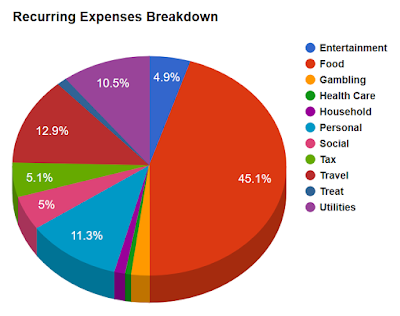 As expected, my top expenses are food, utilities, personal and travel. Other random discoveries:
- I spent about $12-$15 on average each month on lottery tickets. -.- So far, I only "won" $10 back. They are indeed a bad investment. Treat them purely as entertainment.
- Of all the entertainment expenses, about 50% of them comes from KTV sessions. LOL. Does it imply most of my entertainment come from singing, or is it because singing is the most expensive form of entertainment?
Food: Breakfast, Lunch, Dinner, Supper, Snack, Groceries
Entertainment: Any form of entertainment expenses such as KTV, Video Games (e.g. Purchases from Steam), Movies, Sports, Etc
Gambling: Any Losses from Lottery, Mahjong, etc...
Healthcare: Doctor, Dentist
Household: Consumables (e.g. Stationary, Toiletries), Others (e.g. Pillow, Bedsheets)
Personal: Things that are consumed personally by me, such as Clothing (e.g. Head to Toes), Haircut, Personal Care (e.g. Toothpaste, Skincare, Grooming), Other (i.e Exercise Stuff, Army)
Social: Wedding, Social Functions
Tax: Income Tax
Travel: Public (e.g. EZ-Link Topup), Taxi
Treat: Non-personal expenses
Utilities: Telephone, Internet
----------------------------------------------------------------------------------------------------------------------
Road To Financial Independence
 Passive income now cover almost 20% of my expense! Not bad for my first full year of investing!
I have exceeded my goal for 2015 by collecting more passive income. The short term negative impact though - it's like exchanging "capital losses" in the process.
Given the market correction (i.e Great Singapore Sale), I will selectively accumulate on weakness to further accelerate my yield next year. Goal next year is to generate 1 month salary from stock dividends.
*All figures exclude CPF, investment capital gains/losses (but include dividends).
-------------------------------------------------------------------------------------------------------------------------
Total Income VS Total Expenses

Income were highest in January and March from bonuses, and there's a minor National Day bonus in August. Can't wait for the upcoming one to top-up my war chest!
 Other
fluctuations in income are mostly due to dividends payout. Being my
first year of investing, this will take some time to stabalize as I
"lock down" on the stocks I have (receiving full year worth of
dividends), and having each subsequent purchase make up less of my
portfolio.
Overall, I managed to saved near 82% of my total income. My plan is to reinvest and inject at least 70% into my portfolio every year. Let's get the snowball rolling!
-------------------------------------------------------------------------------------------------------------------------
Recurring Income VS Recurring Expenses

The chart strips out the noise and highlight only the "recurring" portion of my cashflow.
Recurring income include only salary + passive income, and excludes 'one-time' items like lottery winnings, angbaos, SAF allowance, bank special promotions, etc...
Recurring expenses remove all "major purchases" and "vacations".
-------------------------------------------------------------------------------------------------------------------------
Recurring Expenses Breakdown
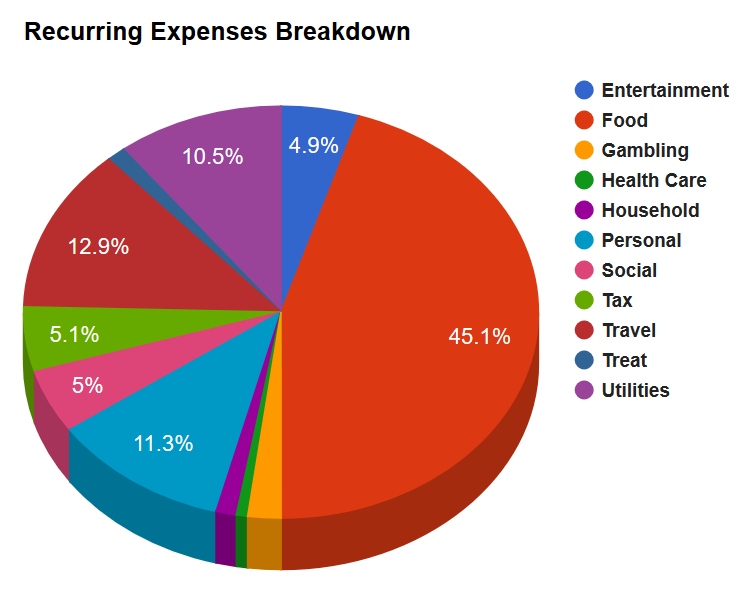
- I spent about $12-$15 on average each month on lottery tickets. -.- So far, I only "won" $10 back. They are indeed a bad investment. Treat them purely as entertainment.
- Of all the entertainment expenses, about 50% of them comes from KTV sessions. LOL. Does it imply most of my entertainment come from singing, or is it because singing is the most expensive form of entertainment?
Food: Breakfast, Lunch, Dinner, Supper, Snack, Groceries
Entertainment: Any form of entertainment expenses such as KTV, Video Games (e.g. Purchases from Steam), Movies, Sports, Etc
Gambling: Any Losses from Lottery, Mahjong, etc...
Healthcare: Doctor, Dentist
Household: Consumables (e.g. Stationary, Toiletries), Others (e.g. Pillow, Bedsheets)
Personal: Things that are consumed personally by me, such as Clothing (e.g. Head to Toes), Haircut, Personal Care (e.g. Toothpaste, Skincare, Grooming), Other (i.e Exercise Stuff, Army)
Social: Wedding, Social Functions
Tax: Income Tax
Travel: Public (e.g. EZ-Link Topup), Taxi
Treat: Non-personal expenses
Utilities: Telephone, Internet
----------------------------------------------------------------------------------------------------------------------
Road To Financial Independence

I have exceeded my goal for 2015 by collecting more passive income. The short term negative impact though - it's like exchanging "capital losses" in the process.
Given the market correction (i.e Great Singapore Sale), I will selectively accumulate on weakness to further accelerate my yield next year. Goal next year is to generate 1 month salary from stock dividends.
Tuesday, December 29, 2015
Year In Review 2015 - Financial Portfolio
2015 has not been a kind year to investors with the market taking
quite a beating. Most people would be in the red and I am no exception. I must be really 'heng' that that my first full year of investing is the hardest to make money in 78 years. Viewed
positively however, it's actually a good thing for someone in their
early stages of investing - It means I get to accumulate more companies
at fire-sale prices!

While I would like to think that I am "out-performing" the index, the sample size (investing period) is really too small to make any conclusion. Still, it's a consolation point to know that it's not because of my bad choices that I'm in the red - the whole market is going down.
 Thankfully,
I still have the majority of my holdings in cash. In 2016, I will look
to selectively inject more into solid blue chips (with long term,
sustainable dividends) to further diversify my holdings.
--------------------------------------------------------------------------------------------------------------------------
Next up will be a brief review of all my holdings and lessons learned:

Frasers Centrepoint Trust
 My
first and most trusted holding. Each visit to causeway point just boost
my confidence in this company. Economic recession? Property downturn? I
don't think these macro-economic factors will make much of a dent on
FCT. It's amazing 8 years consecutive DPU increase is unmatched in the
REITs sector.
This have provided me with the most stable and biggest returns since I started investing, and I intend to hold it forever.
Super Group
 A
costly lesson in not blindly following analyst reports. I went in way
too early in the midst of a downturn, catching a falling knife in the
process. Have been holding on for several reasons:
1) Cyclical stock that should turn-around eventually.
2) Strong balance sheet, good management and still profit-making.
3) The nose-dive makes this only a small portion of my portoflio now, so there is really no point selling anyway.
Keeping my fingers cross that its newly launched Essenso coffee will take off.
China Merchant Pacific Holdings
 Another
one of my "dividend cash-cow". It has a diversified portfolio of 8 toll
roads now in China. While there are worries of slowing China growth, I
am satisfied with the current yield.
The interest hike has been weighing down on the stock price, but with its track record and strong parent backing, it's the least of my worries.
Like FCT, I intend to hold this for a long time. Keep calm and collect dividends!
Sembcorp Industries
 OUCH!
To be fair, no one could have foresee oil prices plummeting from $120+
to $40. Sembcorp has been massacred, burning many people in the
process.It was so bad that Marine even posted a loss for the first time
in the company history. Thankfully, the Utilities are helping to offset
the losses, with potential growth coming from overseas segment.
Not going to sell this as I still believe strongly in "ah gong" stocks. At the same time, I can't average down as it will make me too over-weighted in a single company. If opportunity arises, I may look to "average down" via Keppel Corp to capitalize on the potential oil recovery.
M1
 A
valuable lesson to be learn about being patient. I was too hasty to
deploy my cash after my bonus and didn't wait for a more opportune
moment (like now! A Telco with 7% yield now are you kidding me!).
Many fellow investors, myself included, did not expect the 4th Telco news to impact M1 so negatively.
Its fundamentals didn't change much at all - earnings were still growing steadily and they are exploring new avenues of growth. To me, it's really cheap now and I would definitely want to buy if it weren't for the same ugly problem of over-concentration.
Just think about it. 4th Telco or not, we are heading for 6.9 million population. That means more people, more subscribers, more money for Telcos. If I could, I will definitely buy every single Telco and wait for 2030. Confirm huat lah!
Capital Commercial Trust
 While the price has taken quite a beating after I brought, I am quite comfortable with this holding.
1. I entered at a reasonable price, with a good 20% discount to NAV, near its 52 week and historical P/E low.
2. Confidence in the management track records and grade A properties.
Even though there are headwinds of office over-supply, I don't think it will impact the DPU too badly. In the best case, CapitaGreen should provide some form of growth. In the worst case, a stagnating DPU for next 2 years - still satisfactory for me.
Accordia Golf Trust
 I
already know this is quite a 'risky' buy, but definitely didn't expect
the DPU to drop so drastically. A few reasons why I brought:
1. Seduced by its unbelievably high yield (>10%) and 30% discount to NAV.
2. The false sense of security that "it can't get much lower!" (30+% from IPO price), a deadly fallacy.
3. Convinced by several bloggers - AK is still fighting on, B has backed out.
I am still holding on for its current annualized 7.2% yield, albeit with more risk. The management has been touting the return of golf to the 2016 Oylmpic Games as a growth pillar. Let's see if that comes true.
Straits Times Index
 I
have been deliberating between the various banks when the bear hits in
September. In the end, I fled to safety and brought the STI. Haha.
This is a safety net for me, and I entered at a really good price. Now the issue is when, or should I sell? Looking to add either DBS or OCBC if I do sell this.

While I would like to think that I am "out-performing" the index, the sample size (investing period) is really too small to make any conclusion. Still, it's a consolation point to know that it's not because of my bad choices that I'm in the red - the whole market is going down.

--------------------------------------------------------------------------------------------------------------------------
Next up will be a brief review of all my holdings and lessons learned:

Frasers Centrepoint Trust
 My
first and most trusted holding. Each visit to causeway point just boost
my confidence in this company. Economic recession? Property downturn? I
don't think these macro-economic factors will make much of a dent on
FCT. It's amazing 8 years consecutive DPU increase is unmatched in the
REITs sector.
This have provided me with the most stable and biggest returns since I started investing, and I intend to hold it forever.
Super Group
 A
costly lesson in not blindly following analyst reports. I went in way
too early in the midst of a downturn, catching a falling knife in the
process. Have been holding on for several reasons:
1) Cyclical stock that should turn-around eventually.
2) Strong balance sheet, good management and still profit-making.
3) The nose-dive makes this only a small portion of my portoflio now, so there is really no point selling anyway.
Keeping my fingers cross that its newly launched Essenso coffee will take off.
China Merchant Pacific Holdings
 Another
one of my "dividend cash-cow". It has a diversified portfolio of 8 toll
roads now in China. While there are worries of slowing China growth, I
am satisfied with the current yield.
The interest hike has been weighing down on the stock price, but with its track record and strong parent backing, it's the least of my worries.
Like FCT, I intend to hold this for a long time. Keep calm and collect dividends!
Sembcorp Industries
 OUCH!
To be fair, no one could have foresee oil prices plummeting from $120+
to $40. Sembcorp has been massacred, burning many people in the
process.It was so bad that Marine even posted a loss for the first time
in the company history. Thankfully, the Utilities are helping to offset
the losses, with potential growth coming from overseas segment.
Not going to sell this as I still believe strongly in "ah gong" stocks. At the same time, I can't average down as it will make me too over-weighted in a single company. If opportunity arises, I may look to "average down" via Keppel Corp to capitalize on the potential oil recovery.
M1
 A
valuable lesson to be learn about being patient. I was too hasty to
deploy my cash after my bonus and didn't wait for a more opportune
moment (like now! A Telco with 7% yield now are you kidding me!).
Many fellow investors, myself included, did not expect the 4th Telco news to impact M1 so negatively.
Its fundamentals didn't change much at all - earnings were still growing steadily and they are exploring new avenues of growth. To me, it's really cheap now and I would definitely want to buy if it weren't for the same ugly problem of over-concentration.
Just think about it. 4th Telco or not, we are heading for 6.9 million population. That means more people, more subscribers, more money for Telcos. If I could, I will definitely buy every single Telco and wait for 2030. Confirm huat lah!
Capital Commercial Trust
 While the price has taken quite a beating after I brought, I am quite comfortable with this holding.
1. I entered at a reasonable price, with a good 20% discount to NAV, near its 52 week and historical P/E low.
2. Confidence in the management track records and grade A properties.
Even though there are headwinds of office over-supply, I don't think it will impact the DPU too badly. In the best case, CapitaGreen should provide some form of growth. In the worst case, a stagnating DPU for next 2 years - still satisfactory for me.
Accordia Golf Trust

1. Seduced by its unbelievably high yield (>10%) and 30% discount to NAV.
2. The false sense of security that "it can't get much lower!" (30+% from IPO price), a deadly fallacy.
3. Convinced by several bloggers - AK is still fighting on, B has backed out.
I am still holding on for its current annualized 7.2% yield, albeit with more risk. The management has been touting the return of golf to the 2016 Oylmpic Games as a growth pillar. Let's see if that comes true.
Straits Times Index

This is a safety net for me, and I entered at a really good price. Now the issue is when, or should I sell? Looking to add either DBS or OCBC if I do sell this.
Saturday, December 26, 2015
To My Future FI Self
Hopefully, you've managed to achieved FI before the age of 40. Are you planning to retire/semi-retire already?
Unfortunately, this is not something that is socially acceptable in Singapore. Your friends and families probably think it's a crazy, absurd dream. In a society where we are encouraged to work until we are 67 years old, wanting to retire early sounds ridiculous. You will be criticized or deem as weird/lazy. Quote from a fellow investor who reached FIRE:
"I had trouble convincing authorities that I was not a burden to the tax-payer in spite of being an unemployed law student. Our government is still not equipped with the procedures to cover income investors. I had to compile a report on dividend cash flows and had to deal with an ICA officer who was just puzzled that "stock market sends me money on regular basis". In a more unsophisticated country, I would have been accused of practicing witchcraft.
The second incident which may have killed my retirement plan is when I tried to hire a maid to look after my dad. Without an earned income in my IRAS filings, I was not allowed to be the sponsor. My dad had to put in his spare cash of $50,000 into a fixed deposit to sponsor his own maid as all my money is tied up in my CDP. This convinced me that Singapore society, as affluent as it is, it does not have the infrastructure in place to recognise dividends cash flow as a valid substitute for earned income. A CDP statement, no matter how large, is no substitute for a FD account which puts us in a bind because of the cash drag."
Perhaps that's why I haven't been sharing this dream of mine with many people. B sums up this dilemma perfectly in his recent post.
It's like getting married. It's something we are expected to do out of social norms, regardless of how much pain it would bring us.
If you are already FI, you shall remember and follow these advice:
-----------------------------------------------------------------------------------------------------------------
1. Thou shalt not become a slave of money
It will be difficult to give up working when you realize how much income you will lose, even after you have enough passive income to live without working. It will be tempting to chase after more and more zeroes in your bank account. This will never end - humans greed are limitless.
Before you know it, you'll reach the end of your life being a slave to money. Do not let that happen to you. Do not let society norms determine your future.
2. Thou shalt follow your heart, dreams and passion
You promised that you will do that. Remember your initial goal when you started on this journey.
Your dream job pays much lesser than your current one? You can afford to switch now.
You wanted to take a long sabbatical to enjoy life? Do it.
You wanted to go back to school, learn something new? Do it.
Do not falter. Do not forget the initial reason you started on the journey to FI.
3. Thou shalt not shift your goalpost.
It's easy to shift goal post and make the criteria for achieving FI harder and harder.
While it is prudent to take inflation and cost of living into account, you must not adjust your lifestyle to chase higher material wealth, making it so you never reach the goal.
Remember the value you set initially and adjust it accordingly.
4. Thou shalt regularly evaluate your financial situation
Remember, it doesn't mean you have to stop working for the rest of your years. We need to set in buffer for financial crisis and bad times.
Do not squander your portfolio. Do not spend your invested capital. Only spend the dividends, with enough left over to reinvest and grow your portfolio.
Unfortunately, this is not something that is socially acceptable in Singapore. Your friends and families probably think it's a crazy, absurd dream. In a society where we are encouraged to work until we are 67 years old, wanting to retire early sounds ridiculous. You will be criticized or deem as weird/lazy. Quote from a fellow investor who reached FIRE:
"I had trouble convincing authorities that I was not a burden to the tax-payer in spite of being an unemployed law student. Our government is still not equipped with the procedures to cover income investors. I had to compile a report on dividend cash flows and had to deal with an ICA officer who was just puzzled that "stock market sends me money on regular basis". In a more unsophisticated country, I would have been accused of practicing witchcraft.
The second incident which may have killed my retirement plan is when I tried to hire a maid to look after my dad. Without an earned income in my IRAS filings, I was not allowed to be the sponsor. My dad had to put in his spare cash of $50,000 into a fixed deposit to sponsor his own maid as all my money is tied up in my CDP. This convinced me that Singapore society, as affluent as it is, it does not have the infrastructure in place to recognise dividends cash flow as a valid substitute for earned income. A CDP statement, no matter how large, is no substitute for a FD account which puts us in a bind because of the cash drag."
Perhaps that's why I haven't been sharing this dream of mine with many people. B sums up this dilemma perfectly in his recent post.
It's like getting married. It's something we are expected to do out of social norms, regardless of how much pain it would bring us.
If you are already FI, you shall remember and follow these advice:
-----------------------------------------------------------------------------------------------------------------
1. Thou shalt not become a slave of money
It will be difficult to give up working when you realize how much income you will lose, even after you have enough passive income to live without working. It will be tempting to chase after more and more zeroes in your bank account. This will never end - humans greed are limitless.
Before you know it, you'll reach the end of your life being a slave to money. Do not let that happen to you. Do not let society norms determine your future.
2. Thou shalt follow your heart, dreams and passion
You promised that you will do that. Remember your initial goal when you started on this journey.
Your dream job pays much lesser than your current one? You can afford to switch now.
You wanted to take a long sabbatical to enjoy life? Do it.
You wanted to go back to school, learn something new? Do it.
Do not falter. Do not forget the initial reason you started on the journey to FI.
3. Thou shalt not shift your goalpost.
It's easy to shift goal post and make the criteria for achieving FI harder and harder.
While it is prudent to take inflation and cost of living into account, you must not adjust your lifestyle to chase higher material wealth, making it so you never reach the goal.
Remember the value you set initially and adjust it accordingly.
4. Thou shalt regularly evaluate your financial situation
Remember, it doesn't mean you have to stop working for the rest of your years. We need to set in buffer for financial crisis and bad times.
Do not squander your portfolio. Do not spend your invested capital. Only spend the dividends, with enough left over to reinvest and grow your portfolio.
Subscribe to:
Posts (Atom)